
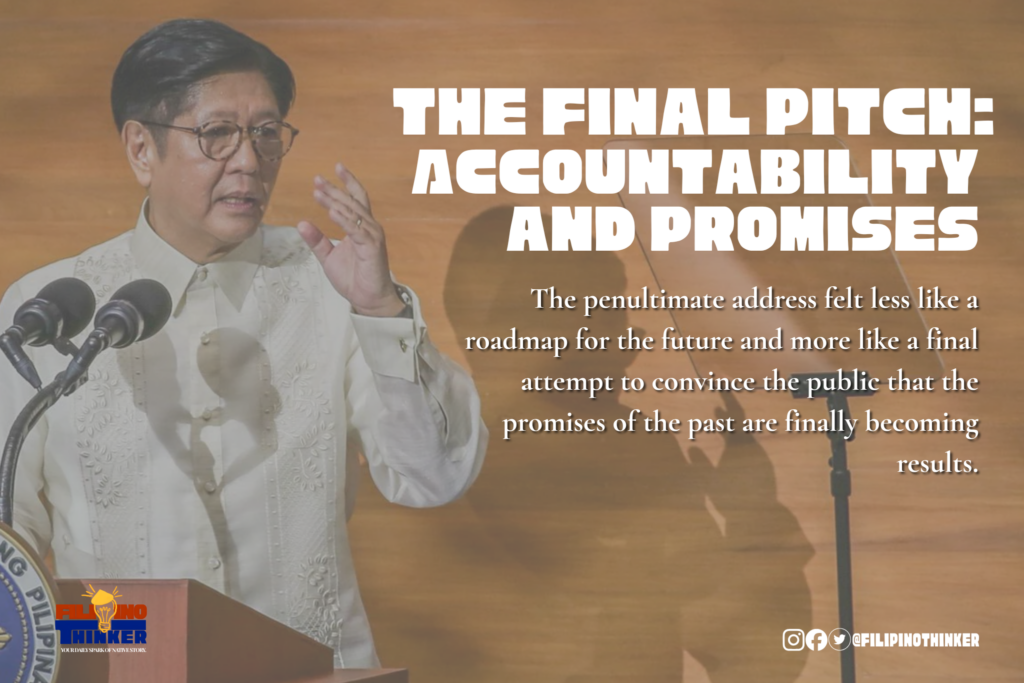
Delivering his fifth State of the Nation Address (SONA), President Ferdinand Marcos Jr. officially entered the final stretch of his six-year term with a clear pivot from grand promises to a reckoning of accomplishments. His penultimate address sought to draw a distinct line between laying the groundwork of Bagong Pilipinas and delivering tangible, lasting results before his time in office expires.
The speech’s most explosive moment picked up directly on the massive flood control scandal, as Marcos signaled that the government’s sweeping probe into ghost and substandard infrastructure is moving toward criminal prosecution. Declaring that even political kin would not be spared—alluding to impending charges against former House Speaker Martin Romualdez—the President projected a rare willingness to sacrifice internal political alliances for public accountability. Whether these charges lead to conviction or political theater remains the true test for a skeptical public.
Navigating a tough economic climate exacerbated by global fuel spikes and persistent cost-of-living worries, Marcos leaned heavily into populist economic policy. He urged Congress to overhaul the Electric Power Industry Reform Act (EPIRA) to ban utility companies from passing “systems loss” charges onto electricity consumers, while dangling middle-class tax relief for workers earning ₱350,000 or less. These proposals directly target everyday household pain points, though their success relies entirely on legislative willingness to fight powerful energy and financial lobbies.
On foreign policy and territorial defense, Marcos reaffirmed his firm, uncompromising stance on the West Philippine Sea. Anchored by his rousing declaration, “We are Filipinos, and we do not yield,” his administration continues to carve out a sharp contrast with previous geopolitical posturing. By codifying maritime features and asserting sovereign rights on international stages, defending Philippine territory has solidified into one of his signature policy pillars.
Ultimately, this fifth SONA served as both an accounting of progress and a high-stakes roadmap for his final two years. As time runs short for the administration, flashy announcements must now give way to concrete execution. If the President can turn his anti-corruption pledges, energy reforms, and sovereign defense into real relief for ordinary households, he may secure a meaningful legacy; if not, his speech will simply join a long tradition of ambitious SONA roadmaps left unfinished.
Leave a Reply